
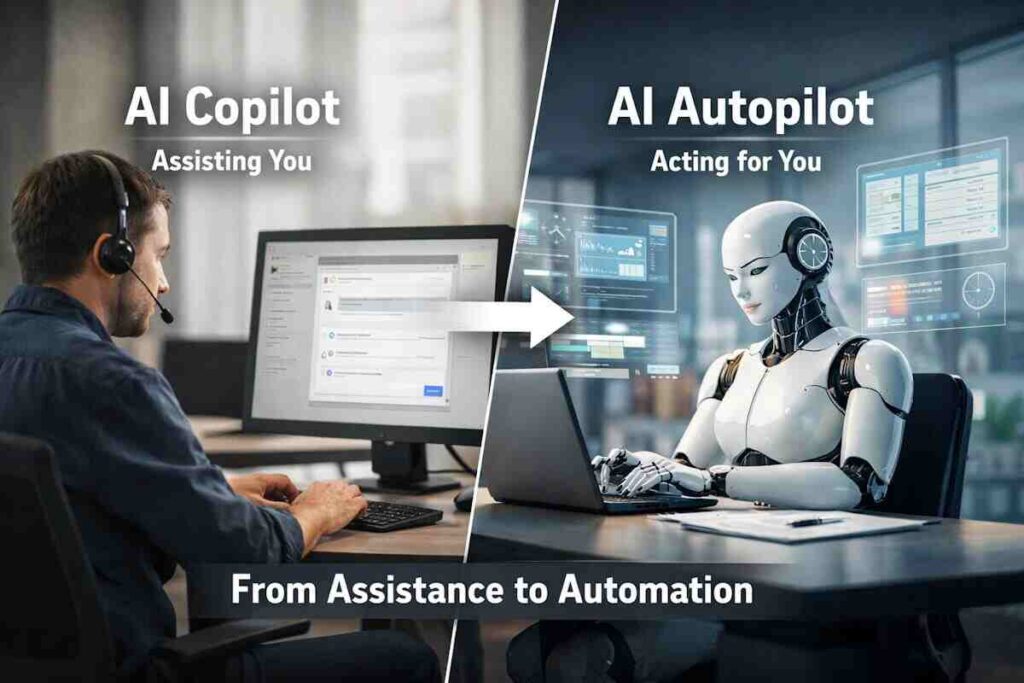
Let’s be real — “AI” is tossed around so often that most people just nod and move on. It’s everywhere. But here’s where it gets interesting: the shift from copilots to full-on autopilots. That’s not just a tech trend. It’s changing how businesses operate — for real.
And if you’re sitting there wondering what this means for you or your business, especially if you’re thinking about working with an ai development service, you’re in the right place.
We’re talking about software that can actually make decisions, not just suggest things. It can execute tasks without waiting for you to hit “OK.” That’s what folks are starting to call agentic AI. Let’s break that down in plain terms and see how we got from helpers (copilots) to full-blown taskmasters (autopilots).
The Copilot Phase: Assistive but Passive
Let’s start with the copilot phase. Think about your favorite email app suggesting replies. Or your CRM filling out fields based on previous entries. Or tools that help you write better, faster.
They’re helpful. They save time. But they’re still waiting on you.
They need you to take the final step — click, approve, confirm. You’re still flying the plane; they’re just telling you where the storm is. This is the world’s most businesses are still in.
And to be fair, that’s not a bad place to be. Most teams rely on these assistant-type tools every day. They’re useful. They increase output. But they’re not really doing anything on their own. No judgment calls. No actions taken without someone behind the wheel.
That’s where things are starting to change.
Enter Agentic AI: From Suggesting to Doing
Agentic AI isn’t waiting for you.
It acts.
Say you run a support center. Instead of AI simply drafting a response for a customer ticket and waiting for approval, now it sends that message — then follows up. Then logs the response. Then closes the ticket. Automatically.
It doesn’t need a manager to babysit it. It handles tasks based on context, past behavior, rules, and goals you’ve already set.
Now imagine applying that kind of hands-off execution to your workflows, product development, data analysis, marketing campaigns — even hiring.
You can see how fast things are moving. And if you’re not thinking about where to plug into this shift, you might be stuck playing catch-up later.
What Makes Agentic AI Different?
Let’s keep it simple.
Traditional AI:
- Waits for input
- Gives recommendations
- Helps, but doesn’t act on its own
Agentic AI:
- Understands tasks and goals
- Takes action without constant human input
- Can initiate, plan, and complete multi-step tasks
This isn’t some sci-fi fantasy. It’s already showing up in logistics, e-commerce, HR tech, and software development. Companies that once relied on human teams to coordinate every little thing are now seeing AI tools do the legwork.
And it’s not just about cutting costs. It’s about speed. Decisions happen faster. Execution is smoother. You don’t need a human to tell the system what to do next — it just does it.
That’s the big deal.
So What’s the Role of an AI Development Service?
If this all sounds wild but you’re not sure how to get started, you’re not alone.
Building agentic systems isn’t something most in-house teams can handle from scratch. That’s where an AI development service comes in.
But not all services are equal.
Some are still stuck building basic chatbots or single-purpose automations. That’s fine for entry-level stuff. But if you want something smarter — a system that knows when to step in, how to make decisions, and how to execute workflows — you need a team that’s done this before.
A solid AI partner will:
- Help map out your goals and processes
- Build systems that align with your actual work
- Train models with data that makes sense for your use case
- Avoid buzzwords and just focus on what works
If your team doesn’t have the time or skillset to build something agentic, outsourcing to a well-matched ai development service could be the shortcut you need.
Agentic AI in Hiring: More Than Just Screening
Now let’s talk about hiring.
You’ve seen tools that scan resumes, rank candidates, maybe even auto-schedule interviews. That’s copiloting.
Now picture this: an AI Hiring Platform that handles the full process. It doesn’t just scan resumes — it invites candidates, asks follow-up questions, scores them based on live interaction, and even provides feedback to hiring managers.
No more juggling dozens of spreadsheets or playing email tag with applicants. The system runs its own processes.
This kind of setup helps startups, tech teams, and even large enterprises speed up hiring without losing accuracy.
And when you’re ready to scale, these platforms can keep running without needing to expand your recruiting team. That’s a real shift — especially in industries where good talent is tough to find.
How to Hire AI Developers Who Get This Stuff
If you’re more on the product or engineering side, the next logical step is thinking about how to hire AI developers who actually know what they’re doing.
Spoiler: Not every dev with “AI” on their resume is ready for agentic systems.
You need people who:
- Understand decision-making logic
- Can handle real-world edge cases
- Know how to train systems that don’t go off the rails
- Care about user experience just as much as backend logic
This isn’t just math or code. It’s about building tools that people can trust to run without constant oversight.
So, whether you go through an AI Hiring Platform or work with an ai development service, ask the right questions. Look at past projects. See how they think through workflows. Find out how much manual input their systems still need.
Because if the end product still needs a human to check every step, you’re not in autopilot mode. You’re still copiloting — and that might hold you back.
What’s Next for Agentic AI?
This shift won’t happen overnight. Most companies are still in transition. But the tech is moving fast, and the use cases are expanding.
You don’t have to go all in tomorrow. But you should be asking questions now:
- Where can we reduce manual steps?
- What parts of our process don’t need constant supervision?
- How can we build (or buy) systems that act on our behalf?
The answers might lead you to build in-house. Or to partner with a provider offering serious ai development service options. Or maybe to plug into an AI Hiring Platform that automates more of your people ops.
Whatever the path, one thing’s clear: the age of just copiloting is fading out. Autopilot is here — and it’s not slowing down.